IMPORTANT NOTE: The required resources indicated are estimates only. They will depend on the number of stores, the selected architecture, the type of store, the number of POS terminals per store, the volume of generated data (daily receipts and average receipt length), as well as other connected in-store elements such as Self Check-out (SCO), FastPOS or Scan&Go apps. In the case of e-commerce, resources will vary depending on the expected number of visits. For peaks in online traffic, a high-availability environment is recommended, as it enables very easy scaling.
APPLICATION SERVER REQUIREMENTS BASED ON DEPLOYMENT TYPE
Technical specifications vary depending on the selected deployment model.
1- BASIC DEPLOYMENT (WITHOUT HIGH AVAILABILITY):
comerzzia can be deployed on virtual machines using container technology (Docker), or through a traditional on-premise or cloud deployment.
2- HIGH-AVAILABILITY DEPLOYMENT AND/OR DISTRIBUTED ENVIRONMENTS
comerzzia uses Kubernetes technology, based on virtual containers, to deploy its microservices. The power of this platform enables agile scalability, high availability and the well-known advantages of distributed environments. Scalability, whether automatic or manual, by increasing or decreasing the resources dedicated to microservices, is one of Kubernetes’ key strengths. This makes it possible to dynamically adapt available resources to processing peaks caused by changes in demand across physical or digital stores, often driven by campaigns or specific marketing actions. High availability is achieved by defining multiple nodes with the same functionality, which distribute workloads and take over in the event of failure of other nodes, helping to maintain the defined service levels.
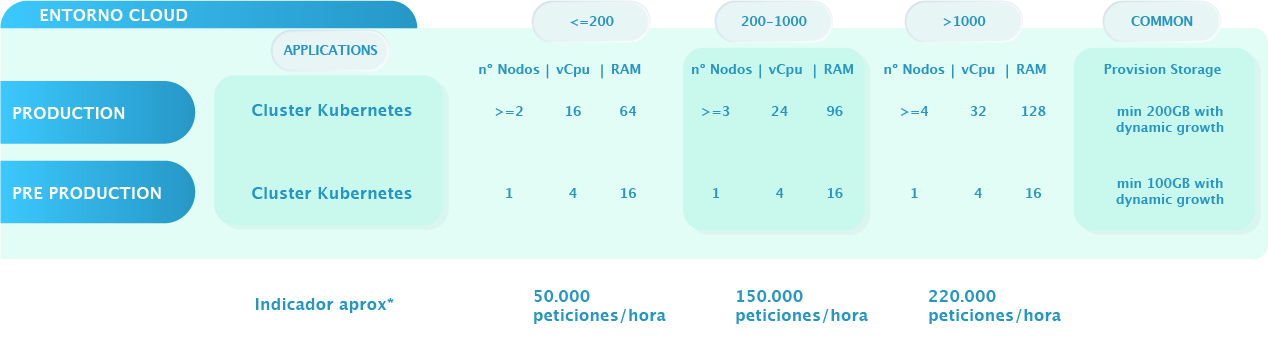
*These values are approximate and depend on the comerzzia capabilities deployed and therefore on the number of transactions (food/non-food), number of stores, number of loyalty customers and number of card movements (social money). The number of requests may be entirely independent of the number of POS terminals or stores. For example, they may come from online stores through the OMS module, from social money, or from coupon and promotion management.
COMPATIBLE OPERATING SYSTEMS
comerzzia is compatible with the following operating systems:
Windows: W7, W10 Professional, W10 PosReady, Win 10 IoT Enterprise 2015 LTSB, Win 10 IoT Ent 2019 LTSC, W10 Professional (Not compatible with: W10 Enterprise 2016 LTSB)
Linux: Debian 9, CentOS 7
NOTE: For installation on any Linux distribution, compatibility with all devices integrated within the store ecosystem must be verified. If any incompatibility exists, the client/partner will be informed so that another viable alternative can be considered.
DATABASE SERVER REQUIREMENTS
Available only in basic deployment mode. Compatible with Oracle, SQL Server, MariaDB and MySQL databases. PostgreSQL support will also be available soon.
The application server environment and the database environment must share the same network in order to avoid latency issues.
It is recommended that the Pre-production and Production databases be hosted on separate instances.
NOTE:The table shows recommended starting values. Depending on the type of business, number of stores and number of POS terminals, it will be necessary to scale resources as required, ranging from several GB to TB.